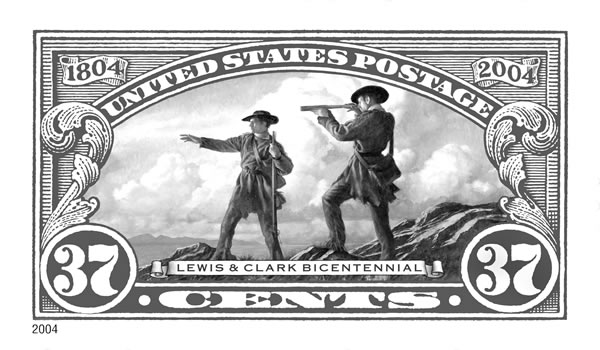
Lewis and Clark in St. Louis
On May 14, 1804, the westward journey of Meriwether Lewis, William Clark, and 38 hunters, cooks, and frontiersmen began at St. Charles on the shores of the Missouri River. Lewis was chosen by Thomas Jefferson to explore the western lands acquired in the Louisiana Purchase. Lewis then turned to William Clark to accompany him and to recruit members who would be beneficial to the expedition. Together, the travelers would be referred to as the Corps of Discovery. Goals of the expedition included charting new animals and plants, documenting the different Native American groups of the regions, and, to find a water passage to the Pacific Ocean known as the Northwest Passage.
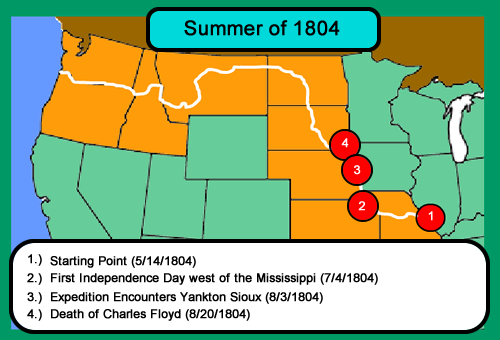 |
The Corps traveled on average 20 miles per day against the current on the Missouri River. On May 20, the expedition sailed past La Charette, the last White settlement on the Missouri River. On July 4th, the expedition celebrated the first Independence Day west of the Mississippi River. To salute the young nation's birthday, the cannons from the keelboats were fired and a creek near present-day Atchison, Kansas was named Independence Creek.
| Did You Know? |
Because the Missouri River rises east of the Continental Divide, the Corps of Discovery was forced to travel against the current of the mighty Missouri River until they reached the divide in the Rocky Mountains.
At 2,341 miles in length, the Missouri River is considered the longest river in the United States. |
On August 3rd, the Corps encountered Native Americans for the first time - the Yankton Sioux in the Great Plains, near present-day Omaha, Nebraska. The Yankton Sioux were presented with various medals and flags and were told of their "Great Father to the East," Thomas Jefferson. On August 20th, Kentucky frontiersman Charles Floyd died, most likely from a burst appendix brought on by appendicitis. Amazingly, Floyd's death would prove to be the ONLY death on the entire two-year expedition. A funeral for Floyd was held on a bluff overlooking the Missouri River. The location was named Floyd's Bluff in his honor. Although appendicitis is usually diagnosed by doctors today before the appendix bursts, in Floyd's time, appendicitis was invariably fatal. |
Discussion Questions
Why was the Missouri River so difficult to travel for the expedition?
What were the main goals of the Corps of Discovery?
Why was Charles Floyd’s death so significant?
What do the gifts given to the Yankton Sioux tell us about the goals of the expedition?
Lewis and Clark in St. Louis
On May 14, 1804, Meriwether Lewis, William Clark, and 38 team members began their journey west from St. Charles, Missouri. President Thomas Jefferson had chosen Lewis to explore the new western lands from the Louisiana Purchase. Lewis picked Clark to join him and help recruit the team, called the "Corps of Discovery." Their goals were to find new plants and animals, meet Native American tribes, and search for a water route to the Pacific Ocean called the Northwest Passage.
Summer of 1804
The team traveled about 20 miles a day going against the strong current of the Missouri River. On May 20, they passed La Charette, the last white settlement on the river. On July 4, they celebrated the first Independence Day west of the Mississippi River by firing the boat cannons and naming a nearby creek "Independence Creek."
Interesting Facts
- The Missouri River flows east from the Rocky Mountains and is the longest river in the U.S. at 2,341 miles.
- Because of the direction of the current, the Corps had to row upstream for much of the journey.
Meeting Native Americans
On August 3, the Corps met the Yankton Sioux near today’s Omaha, Nebraska. They gave the Sioux gifts like medals and flags and told them about their “Great Father to the East,” President Jefferson.
The Only Death
On August 20, Charles Floyd, a frontiersman from Kentucky, died from what was likely a burst appendix. His was the only death on the entire two-year expedition. The team held a funeral on a bluff overlooking the river, later named "Floyd’s Bluff."