Fort Clatsop

Fort Clatsop

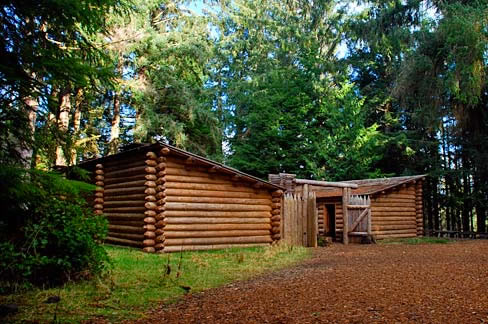
Fort Clatsop Replica near Astoria, Oregon

The winter of 1805-1806 was miserable in the Pacific Northwest. The men worked through a constant rain to build Fort Clatsop – two rough cabins about fifty feet in length that would hold 32 men, one woman, one baby and a dog. Lewis, Clark, Sacagawea, Charbonneau, and baby Jean Baptiste would stay in one cabin, while the remainder of the Corps lived in the other. The Corps stayed at Fort Clatsop for four months hunting the small elk population that lived near the estuary, making clothes from elk hide, trying desperately to make fires with wet wood, and engaging in laborious tasks to keep up the maintenance of the fort in the wake of constant wet conditions. According to one traveler, there were only twelve rainless days the entire winter! The constant rain led to many in the Corps to contract colds and flus and others, including Meriwether Lewis, to become depressed.

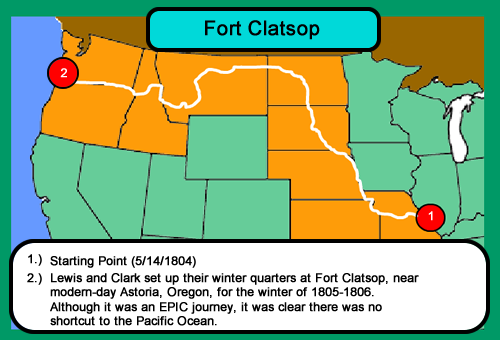
Meriwether Lewis was, however, able to document the region’s plant and animal life as well as the Native Americans who lived there. William Clark worked on drafting the map of lands they had explored, including one that traced their path all of the way from Fort Mandan to Fort Clatsop, which would be valuable to future travelers.

On March 23, 1806, the Corps finally left Fort Clatsop for the long trip back to Missouri.

Lewis and Clark meet the Teton Sioux


Did You Know?

Rainy Pacific Northwest


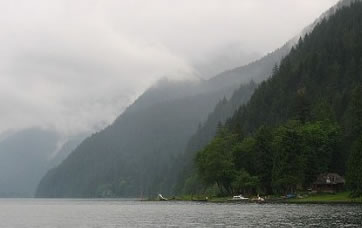
The region in which Lewis and Clark built Fort Clatsop is one of the rainiest places in North America. It receives over 85 inches of rainfall per year, nearly 2.5 times the national average.

Discussion Questions

  1. How did the harsh climate at Fort Clatsop impact the health and morale of the Corps?
  2. What do the records of Lewis and Clark from this winter tell us about their commitment to science and exploration?
  3. Why was Fort Clatsop’s location strategically chosen, despite the difficult weather conditions?
  4. How did the skills and cooperation of the entire Corps contribute to their survival during the winter?

Back | Next: Return Trip

Winter at Fort Clatsop

The winter of 1805–1806 was harsh and wet for the Corps of Discovery as they camped at Fort Clatsop near the Pacific coast. Through constant rain, they constructed two rough cabins—one for Lewis, Clark, Sacagawea, Charbonneau, baby Jean Baptiste, and their dog, and another to house the remaining 32 men. Persistent damp conditions made it nearly impossible to start fires or stay dry, and only twelve days were rain-free that winter.

Surviving the Season

The Corps hunted a limited elk population for food and used elk hides to make clothing. Illnesses like colds and flu spread easily, and the weather took a toll on morale, with even Meriwether Lewis reportedly falling into depression. Despite the hardships, Lewis took time to record the region’s plant and animal life, while Clark drafted detailed maps of their journey.

Departure

On March 23, 1806, after four long months of cold, wet conditions, the Corps of Discovery finally departed Fort Clatsop to begin their return journey to Missouri.

Did You Know?

The area around Fort Clatsop is one of the rainiest in North America, receiving more than 85 inches of rain each year—over twice the national average!

Back | Next: Return Trip