Return Trip

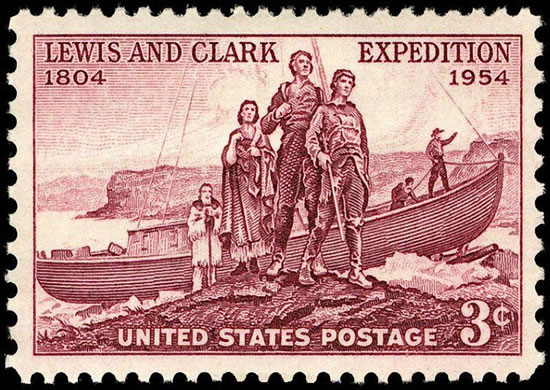
Lewis and Clark Postage Stamp

On March 23rd, 1806, Lewis and Clark and the Corps of Discovery left Fort Clatsop and traveled east against the current of the Columbia River. They took the punishing Nez Perce Trail through seven feet of snow across the Bitterroots. At Traveler’s Rest, Lewis and Clark split up for the purposes of adding to the knowledge they had already gathered. Lewis followed the overland route traditionally taken by the Nez Perce to their buffalo hunting grounds. It led to the Great Falls of the Missouri River. From the Great Falls, Lewis planned to take three men on an expedition to explore the Marias River. Clark and the others would take the same route in which they came until they came to the Three Forks. At the Three Forks, Clark, Sacagawea, Charbonneau, and their baby would cross the valley of the Yellowstone River, which they would follow to the Missouri. Lewis’ division was nearly destroyed by a band of Blackfoot Indians who tried to steal their weapons. In the ensuing struggle, two natives were killed, and the division was forced to flee before a larger band of natives were to chase them. Lewis’ division traveled nearly 100 miles in a period of 24 hours before meeting up with Clark and the rest of the Corps on August 12. The Corps returned to St. Louis on September 23, 1806 as heroes.

The Lewis and Clark adventure was one of the greatest in the history of America. Even though they did not find a water route to the Pacific Ocean, they found hundreds of new species of plants and animals, established relations with many native tribes, mapped much of the Missouri River and Pacific northwest, and confirmed that the continent extended from the Atlantic to the Pacific Ocean. Furthermore, the Lewis and Clark expedition established the potential for a vast American trading empire in which pelts could be transported to the Columbia River estuary and shipped to Asia for Asian trade goods.

Discussion Questions

  1. Why did Lewis and Clark split up on the return journey, and what did they hope to achieve?
  2. How did Lewis's encounter with the Blackfoot reflect the dangers of westward exploration?
  3. What major accomplishments did the expedition achieve despite not finding a Northwest Passage?
  4. How did the expedition help shape the future of American trade and expansion?

Back | Back to Start

The Return Journey

On March 23, 1806, the Corps of Discovery left Fort Clatsop and began their return trip eastward, paddling against the powerful current of the Columbia River. After enduring deep snow along the grueling Nez Perce Trail, they reached Traveler’s Rest, where Lewis and Clark split up to explore more territory and expand their findings.

Exploring New Routes

Lewis took an overland route used by the Nez Perce to the Great Falls of the Missouri River, then explored the Marias River with a small group. Meanwhile, Clark, Sacagawea, Charbonneau, and their son followed the Yellowstone River after crossing at the Three Forks. Lewis’s group narrowly escaped a deadly encounter with a group of Blackfoot warriors, resulting in the deaths of two natives and a desperate 100-mile retreat before rejoining Clark on August 12.

A Hero’s Return

The Corps of Discovery arrived back in St. Louis on September 23, 1806, to a hero’s welcome. Though they didn’t find a water route to the Pacific, they mapped vast new lands, discovered hundreds of plant and animal species, built relationships with Native American tribes, and opened the door to American trade and expansion in the West.

Back | Back to Start