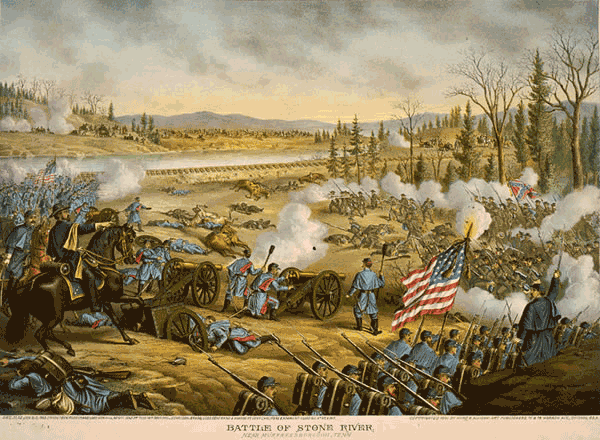
The Battle of Stones River (Murfreesboro) |
|
The Battle for Eastern TennesseeThe Battle of Stones River, sometimes called the Battle of Murfreesboro, was one of the most violent engagements of the Civil War. In the battle, Confederate General Braxton Bragg and as many as 35,000 soldiers withdrew from Kentucky and took defensive positions in the city of Murfreesboro, Tennessee. On the Union side, General William Rosecrans, urged to be aggressive by President Lincoln, moved his army of 81,000, known as the Army of the Cumberland to Nashville, Tennessee, with instructions to take the eastern portion of the state. Rosecrans' PursuitOn December 26, 1862, Rosecrans began to pursue Bragg's army and moved south toward Murfreesboro with about half of his forces. Confederate calvary continually harassed Union lines as they moved, capturing as many as 1,000 soldiers, wagon trains, and ammunition. By December 30th, however, Union forces had descended upon Murfreesboro. Death and Violence on New Year's EveAt 6:00 in the morning on December 31, Confederate forces under William Hardee struck first at the Union right flank. Union troops were initially driven back nearly three miles to the Nashville Turnpike. A second wave of Confederate forces under Leonidas Polk smashed into the reeling Federal troops and seemed poised for a route. Union forces were saved by the foresight of Major General Philip Sheridan, whose soldiers were ready by 4:00 in the morning and repulsed numerous Confederate assaults despite incurring horrible casualties. Sheridan's men would fight through being surrounded by three sides in what came to be known as "the slaughter pen." Despite the Union stand, by 10:00 A.M., 3,000 Union soldiers had been captured as well as 28 cannons. Hell's Half-AcreConfederate forces continued to pound Union positions. Union soldiers on the left flank under Colonel William Hazen managed to repulse numerous assaults in a rocky grove that came to be known as Hell's Half Acre. The remainder of the Union lines collapsed, but were rallied by General Rosecrans along the Nashville Turnpike, where they concentrated and formed strong defensive positions. Union lines held until darkness fell just before 5:00. Confederate General Braxton Bragg believed he had Union forces exactly where he wanted them and that Rosecrans was preparing to retreat. While Confederate forces rested on New Year's Day, Union soldiers shifted soldiers strategically to heights across the Cumberland River. Breckenridge's Men are DecimatedOn January 2nd, Bragg directed what he thought would be a lethal blow to Rosecrans' Army by directing John C. Breckenridge's troops to dislodge Union positions atop a hill on the east side of the Cumberland River. While Breckenridge's brigade initially chased Union forces from the hill, it was decimated by Union artillery fire as it gave chase. Breckenridge's brigade suffered more than 1,800 casualties in less than an hour. As it became clear that Rosecrans and Union lines were soon to receive massive reinforcements, and that the weather was turning the worse, Bragg made the decision to withdraw from the battlefield to Tullahoma, Tennessee, about 35 miles to the South. Nashville is in Union ControlIn all, nearly 24,700 total casualties were recorded at Stones River, giving the battle the distinction of having the highest total percentage of casualties of any battle in the entire war. Nearly one in three soldiers to have set foot on the battlefield was injured, killed, or taken prisoner. Although the battle is considered a draw, Union forces were able to secure Nashville as a center of operations for the entirety of the Civil War, and middle Tennessee was firmly under Union control.
Discussion Questions
The Battle for Eastern TennesseeThe Battle of Stones River, also called the Battle of Murfreesboro, was one of the bloodiest battles of the Civil War. Confederate General Braxton Bragg took up defensive positions in Murfreesboro with 35,000 men after retreating from Kentucky. Union General William Rosecrans, pushed by President Lincoln to act, moved his Army of the Cumberland—81,000 strong—toward Nashville with plans to take eastern Tennessee. Rosecrans' PursuitOn December 26, 1862, Rosecrans led about half of his army south toward Murfreesboro. Along the way, Confederate cavalry attacked Union lines, capturing over 1,000 soldiers and supplies. By December 30, Union troops had arrived near Murfreesboro and were ready to fight. Death and Violence on New Year's EveAt 6:00 AM on December 31, Confederate troops under William Hardee attacked the Union right flank, pushing them back nearly three miles. More Confederate forces under Leonidas Polk hit the shaken Union soldiers hard. Union General Philip Sheridan’s men were prepared and bravely held off attacks even when surrounded on three sides in a spot later called “the slaughter pen.” By 10:00 AM, 3,000 Union soldiers had been captured and 28 cannons lost. Hell’s Half-AcreFighting continued as Union soldiers under Colonel William Hazen held off attacks in a rocky area known as Hell’s Half-Acre. Though many Union positions fell, General Rosecrans formed new defensive lines along the Nashville Turnpike. These lines held until nightfall. Bragg thought the Union was retreating, but during the break on New Year’s Day, Rosecrans quietly moved more troops to high ground across the Cumberland River. Breckenridge’s Men are DecimatedOn January 2, Bragg ordered General John C. Breckenridge to attack the Union hilltop positions. Breckenridge’s troops pushed Union forces off the hill but were crushed by Union artillery as they followed. In less than an hour, Breckenridge lost over 1,800 men. As Union reinforcements approached and the weather worsened, Bragg decided to retreat to Tullahoma, Tennessee. Nashville is in Union ControlNearly 24,700 men were killed, wounded, or captured in the Battle of Stones River—about one in every three who fought. Though the battle ended in a draw, the Union gained control of Nashville and middle Tennessee for the rest of the war, making it a strategic win for the North. |