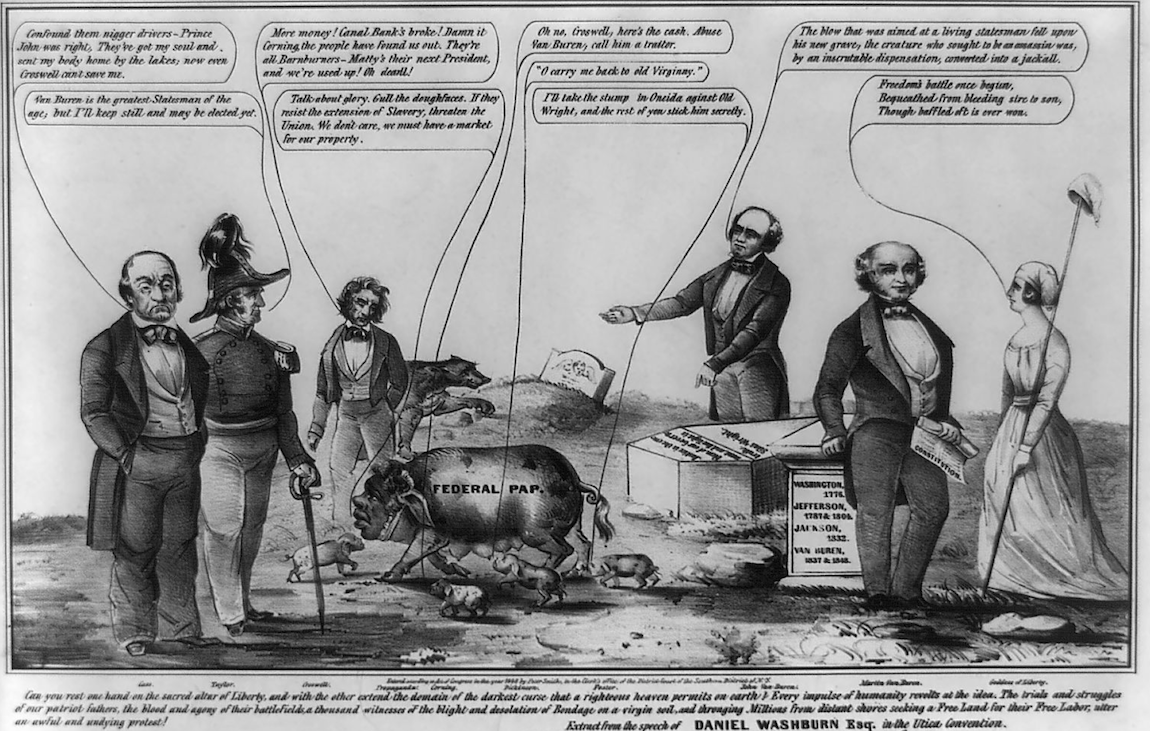
The Free Soilers |
Political Cartoon in support of Free Soil candidate Martin Van Buren |
IntroductionThe Free Soilers were a political faction in the United States during the mid-19th century who emerged as a vocal and influential voice in the debate over slavery and its expansion into new territories. The Free Soil movement, which coalesced into the Free Soil Party in 1848, advocated for the exclusion of slavery from the Western territories acquired through the Mexican-American War, as well as for the promotion of free labor and economic opportunity. Core BeliefsThe Free Soilers drew support from a diverse coalition of abolitionists, anti-slavery activists, small farmers, and laborers who were opposed to the spread of slavery into the Western territories. They believed that the institution of slavery was not only morally wrong but also detrimental to the economic and social well-being of the nation. The Free Soil movement intersected with other political and social movements of the time, including the abolitionist movement, the labor movement, and the women's rights movement. Many Free Soilers were also active participants in these movements, advocating for a broader agenda of social justice and equality. Freedom in the Western TerritoriesCentral to the Free Soil platform was the principle of "free soil, free labor, free men," which emphasized the importance of preserving the Western territories as free states where slavery would be prohibited. Free Soilers argued that the expansion of slavery into the Western territories would undermine the rights of free laborers, lead to the degradation of wages, and perpetuate the power of the Southern slaveholding elite. The Free Soil Party made significant gains in the elections of 1848, winning several congressional seats and garnering a significant share of the popular vote. While the party's presidential candidate, Martin Van Buren, was unsuccessful in his bid for the presidency, the Free Soilers succeeded in bringing the issue of slavery expansion to the forefront of national politics and laying the groundwork for future anti-slavery movements. While the Free Soil Party was short-lived, merging with the Republican Party in the 1850s, its impact on American politics was profound. The Free Soilers helped to galvanize opposition to the spread of slavery, mobilize support for anti-slavery candidates and legislation, and shape the direction of the nation in the years leading up to the Civil War. Discussion Questions
The Free Soil Movement began in the 1840s. Its main goal was to stop slavery from spreading into new lands in the western United States. Supporters believed that these new lands should be used by free white workers, not slaves. They did not always oppose slavery where it already existed, but they wanted to stop it from growing. Why It Caused TensionMany people in the South were angry about the Free Soil Movement. They saw it as a threat to their way of life and to their rights as slave owners. They believed they had the right to take their slaves into any new state or territory. This disagreement created more conflict between the North and South. A Cause of the Civil WarThe fight over whether slavery could expand into new areas made the North and South more divided. The Free Soil Movement was one of the early signs of this growing split. These tensions helped lead to the Civil War in 1861. |