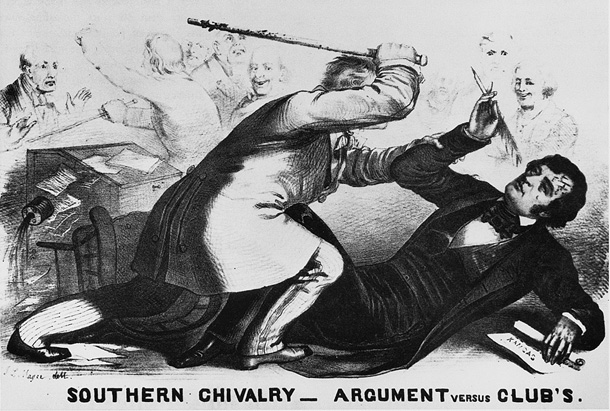
The Caning of Senator Sumner |
|
The Kansas-Nebraska ActIn 1856, the atmosphere in Congress grew increasingly divisive following the 1854 Kansas-Nebraska Act, which allowed popular sovereignty in both territories. Popular sovereignty meant that the people of those territories could vote on whether or not to allow slavery. Kansas was a battleground for those who supported slavery and those who were against slavery. People from both sides rushed into Kansas after the Kansas-Nebraska Act to try to influence the vote. Sumner's Venomous WordsOn May 19th, 1856, Massachusetts anti-slavery, Republican senator Charles Sumner delivered a vituperative speech to the Senate that came to be known as the “Crimes Against Kansas Speech." In the speech he insulted the author of the Kansas-Nebraska Act, Stephen A. Douglas. He saved his most vicious words, however, for South Carolina Senator Andrew Butler. Sumner’s words were so venomous that they were denounced by most Northerners as “un-American.” Only the most radical abolitionists seemed to support the speech. Unfortunately for Sumner, South Carolina representative Preston Brooks was listening. Brooks was a distant cousin of Butler. The Revenge of Preston BrooksOn May 22, Brooks sought out Sumner in the Senate chamber and said, “You’ve libeled my state and slandered my white-haired old relative, Senator Andrew Butler, and I’ve come to punish you for it.” Brooks proceeded to beat Sumner over the head with his cane to the point of unconsciousness. When he was satisfied that the beating was sufficient, Brooks calmly left the scene as stunned onlookers gawked. Brooks Becomes a Martyr of-sortsBrooks resigned from the Senate, but was hailed as a hero throughout the South. Brooks was said to have received dozens of new canes from his new legion of pro-slavery supporters. Northerners were horrified, but hailed Sumner as a hero and leader of the anti-slavery cause. Sumner was severely injured and took years to fully recover. When his injuries finally healed, he served an additional 15 years in the Senate. The beating, now called the Caning of Senator Sumner, served to further strain relations between the North and South and brought the country one step closer to Civil War.Discussion Questions
The Kansas-Nebraska ActIn 1854, the Kansas-Nebraska Act let people in Kansas and Nebraska vote on whether to allow slavery. This idea was called popular sovereignty. Right after the law passed, people on both sides of the slavery issue rushed to Kansas to try to win the vote. The territory quickly became a place of conflict between pro- and anti-slavery groups. Charles Sumner's SpeechOn May 19, 1856, Senator Charles Sumner from Massachusetts gave a strong anti-slavery speech called the “Crimes Against Kansas.” In it, he harshly criticized Senator Stephen Douglas, who wrote the Kansas-Nebraska Act, and especially attacked Senator Andrew Butler of South Carolina. Many people thought Sumner’s speech was too harsh, though some abolitionists supported him. Preston Brooks Takes ActionOn May 22, 1856, Preston Brooks, a South Carolina representative and a relative of Butler, confronted Sumner. He told Sumner he had insulted his state and family. Then Brooks beat Sumner with his cane until Sumner fell unconscious. After the attack, Brooks calmly walked away. The North and South ReactBrooks resigned but was praised as a hero in the South. Supporters even sent him new canes. In the North, people were shocked. They saw Sumner as a hero who stood up against slavery. Sumner was badly hurt and took years to recover, but later returned to the Senate and served 15 more years. Impact on the NationThis event, known as the Caning of Senator Sumner, made tensions between the North and South even worse. It helped push the country closer to the Civil War. |