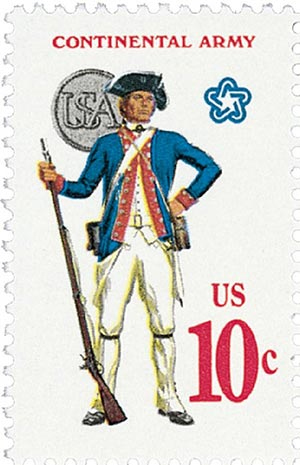
The Continental Army |
||||
MilitiasFor its first 160 years of existence, the colonies that made up England’s North American empire acted more as individual nations than as united colonies. Hence, when tensions with England increased, and the onset of war seemed more and more likely, there was hardly a “national” army to fight the British. At the time, individual colonies relied on their local militias for defense. These militias consisted of citizens, farmers, and laborers who doubled as “soldiers” with weapons. Such militias had little formal military training. Creation of a Permanent ArmyFollowing the Battles of Lexington and Concord in 1775, a colonial army consisting of 26 regiments was formed on orders from the Massachusetts Provincial Congress. Smaller forces were raised throughout New England and New York. The Continental Congress authorized the creation of the Continental Army with these regiments on June 14, 1775. The next day, Congress appointed George Washington as Commander-in-Chief of the army. Although many disliked the idea of a permanent national army, it was deemed necessary in the wake of the British threat. Lacking Supplies and ShelterThroughout the war the Continental Army experienced major problems. Not only were the soldiers in the army inexperienced, but they lacked adequate weaponry, clothes, shoes, and food. Not surprisingly, desertions were frequent and morale was extremely low. Disease, starvation, and hypothermia plagued the Continental Army at its winter quarters at Morristown in early 1777, and at Valley Forge during the winter of 1777-1778. Nearly one in six soldiers wintering at Valley Forge died of typhoid, dysentery, and pneumonia because of the unsanitary conditions and contaminated food. Nutrition was non-existent and the only food that many soldiers ate for months at a time was known as firecake - a simple mixture of flour and water cooked over a fire until it became solid.
Becoming a Military ForceDespite the dreadful conditions and desertions, the Continental Army remained relatively intact under the leadership of George Washington. With the arrival of Baron Steuben at Valley Forge in 1778, the army learned military tactics, formations, training, and discipline, and gradually became a military force that could effectively fight the British in combat. In its first action after Valley Forge, the vastly improved army fought the British to a draw at the Battle of Monmouth Courthouse. Combined with French forces, the Continental Army would stage a successful siege of the British at Yorktown in 1781, which would prove the last major battle of the war.
For the first 160 years, the American colonies acted more like separate countries than a united group. When war with Britain seemed likely, there was no national army. Instead, each colony relied on its own local militia for defense. These militias were made up of everyday people—farmers, workers, and citizens—with little military training. Forming the Continental ArmyAfter the Battles of Lexington and Concord in 1775, Massachusetts created an army of 26 regiments. Other New England and New York colonies followed. On June 14, 1775, the Continental Congress officially created the Continental Army. George Washington was chosen as its commander the next day. Although some feared a national army, it was needed to fight the British threat. Hardships Faced by SoldiersThe Continental Army faced serious problems during the war. Soldiers were often poorly trained and lacked weapons, clothing, shoes, and food. Many deserted, and morale was low. At winter camps like Morristown and Valley Forge, soldiers died from cold, disease, and starvation. Around one in six died during the winter at Valley Forge. The only food many had was "firecake"—a mix of flour and water cooked over a fire. Becoming a Real ArmyDespite poor conditions and many desertions, the Continental Army stayed together under George Washington. In 1778, Baron von Steuben arrived at Valley Forge and trained the soldiers in drills, discipline, and fighting techniques. The army improved and held its own at the Battle of Monmouth Courthouse. In 1781, the Continental Army, with help from the French, trapped the British at Yorktown in the final major battle of the war. |
||||
| Continental Army Activities | ||||
|