Revolutionary War Battles |
|
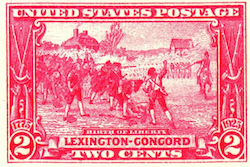 |
On April 19, 1775, the first shots of Revolutionary War were fired at Lexinton, Massachusetts. No one knows which side fired first, but the event became known as "the shot heard round' the world". 73 British soldiers would be killed as they marched back to Concord. |
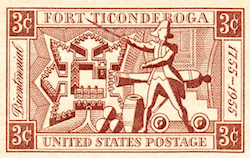 |
On May 10th, 1775, Allen, Arnold and 83 soldiers raided Fort Ticonderoga. The British soldiers, sleeping inside the fort, offered no resistance. No one was killed in the raid. |
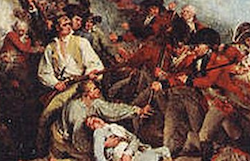 |
Despite ultimately losing ground, Patriot forces proved their strength at the Battle of Bunker Hill on June 17, 1775, inflicting heavy losses on the British in one of the Revolutionary War’s bloodiest early battles. |
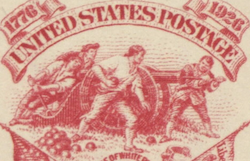 |
The Battles of New York (Harlem and Brooklyn Heights; White Plains) The Battles of New York City in 1776 marked a major British victory during the Revolutionary War, forcing George Washington’s army into retreat and nearly ending the fight for independence. |
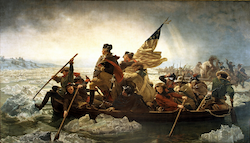 |
Washington's daring surprise attack on December 26, 1776, turned the tide of the Revolutionary War, boosting Patriot morale after a year of setbacks. |
 |
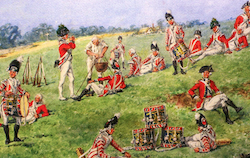
The Battle of Princeton, fought on January 3, 1777, was a pivotal American victory during the Revolutionary War, where General George Washington outmaneuvered British forces in New Jersey, boosting Patriot morale and momentum after the win at Trenton. |
 |
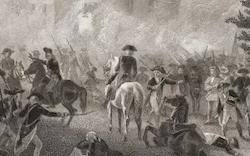
The Battle of Brandywine Creek, fought on September 11, 1777, was a major British victory during the American Revolutionary War, where a surprise flanking maneuver overwhelmed George Washington’s forces and led to the capture of Philadelphia. |
 |
he Battle of Germantown, fought on October 4, 1777, was a bold attempt by George Washington to surprise the British. Though the attack failed due to heavy fog and confusion, it helped gain international attention for the American cause. |
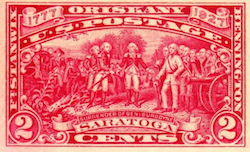 |
On October 7, 1777, Patriots forces under Horatio Gates and Benedict Arnold defeated British forces in the most important Patriot victory in the war to date. Saratoga is often seen as the turning point in the Revolutionary War. |
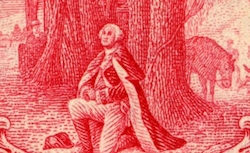 |
The Winter of 1777-1778 at Valley Forge Although not a battle in the traditional sense, the Winter at Valley Forge was a battle for survival. One in six soldiers who spent the winter here died of exposure, disease, or starvation. Those who survived, however, became part of a capable military machine. |
 |
The Battle of Monmouth Courthouse Fought on a sweltering June day in 1778, the Battle of Monmouth Courthouse marked one of the largest battles of the American Revolution—where Continental forces stood their ground against the British, proving their growing strength and discipline. |
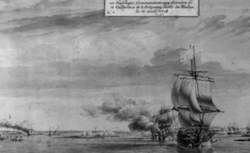 |
The Battle of Newport (1778) marked the first time French and American forces fought together against the British, but despite their efforts, the British maintained control of Newport, highlighting the challenges of coordination between the two allied forces. |
 |
The Battle of Vincennes (1779) was a key American victory, where George Rogers Clark's forces captured the British fort, weakening British control in the Northwest Territory and securing American influence in the region. |
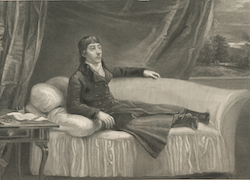 |
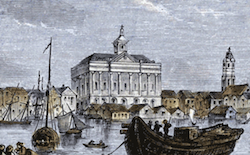
This is an other example of a non-traditional battle, however, it was a battle of sorts between George Washington and a shadowy band of officers who wanted him replaced as Commander-in-Chief for Horatio Gates. |
 |
The Siege of Charleston in 1780 marked the largest American defeat of the Revolutionary War, as British forces captured the city thousands of Patriot soldiers after weeks of relentless bombardment. |
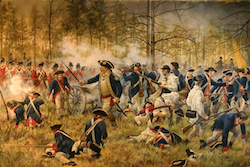 |
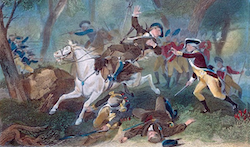
The Battle of Camden, fought on August 16, 1780, was a disastrous defeat for the Patriots, as poorly prepared American forces under General Horatio Gates were overwhelmed by the British, leading to one of the worst losses of the Revolutionary War. |
 |
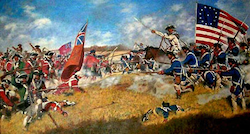
The Battle of Kings Mountain, fought on October 7, 1780, was a decisive Patriot victory during the American Revolutionary War. Frontier militia defeated Loyalist forces in a brutal hillside fight, boosting American morale and turning the tide in the Southern campaign. |
 |
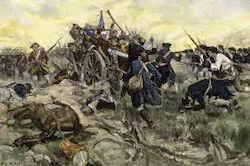
The Battle of Cowpens, fought on January 17, 1781, was a major Patriot victory in the Southern campaign of the Revolutionary War, where General Daniel Morgan's clever tactics led to the defeat and capture of hundreds of British troops. |
 |
The Battle of Guilford Courthouse The Battle of Guilford Courthouse, fought on March 15, 1781, was a costly British victory where General Cornwallis defeated Nathanael Greene’s larger army but suffered heavy losses, weakening British forces and setting the stage for their eventual surrender at Yorktown. |
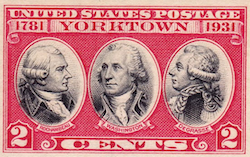 |
The final major battle of the Revolutionary War occurred in October of 1781, when Generals George Washington and Comte de Rochambeau led a successful siege on British forces under Charles Cornwallis. Cornwallis was forced to surrender over 8,000 soldiers. |