The Erie Canal - 1825 |
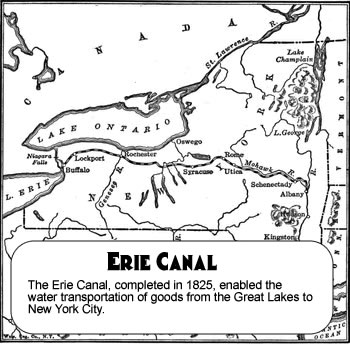
Transportation Between the Atlantic Ocean and Great LakesDuring the early 1800's, the new United States of America began to develop plans to build a waterway to transport goods from the Atlantic Ocean to the Great Lakes region through the imposing Appalachian Mountains. Prior to construction of the Erie Canal, the transportation of goods to the western states was cumbersome and very expensive. New York to Pay for Construction of the Erie CanalIn 1816, a plan was formulated to make the Erie Canal. The canal would link the major port of New York City to the Hudson River near Troy, New York. From Troy, the canal would then link the Hudson River to western cities in New York such as Rome, Syracuse, Rochester and Buffalo. From Buffalo, on Lake Erie, goods could be transported to the canal from the western Great Lakes. Hence, goods could be shipped from anywhere in the Great Lakes to major urban centers such as New York City. Although the plan was rejected by president James Monroe, the New York State Legislature approved the plan and planned to pay for the canal by charging tolls for those who used it. Governor DeWitt Clinton was a major proponent of the plan.Seven Years in the MakingThe canal took over seven years to complete. Laborers had to literally dig the massive canal with simple shovels through mountainous areas. Farmers who lived along the canal often contracted workers to build portions of the canal through their land. Many foreign immigrants were paid well to help build the canal. The 363 mile-long, 40 foot wide Erie Canal was completed on October 25, 1825. The Erie Canal Prompted the Growth of Cities near the Great LakesThe Erie Canal revolutionized life for many in America. Not only did its construction result in drastic differences in shipping costs, but it prompted huge population growths in the Great Lakes region. People began to move closer to large cities because goods could easily be transported via the Erie Canal to urban areas, and goods could also be shipped west from the cities. The $7,000,000 cost of the canal was quickly covered by tolls. Tolls were eliminated soon after the cost of the canal was reclaimed.
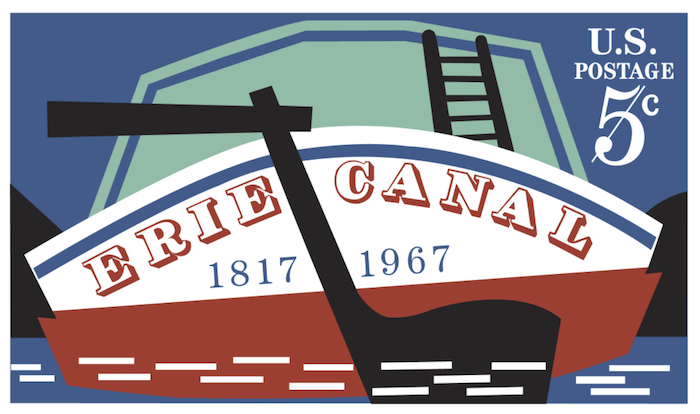
Erie Canal Postage Stamp Transportation Between the Atlantic Ocean and Great LakesIn the early 1800s, the U.S. planned a waterway to move goods between the Atlantic Ocean and the Great Lakes, crossing the Appalachian Mountains. Before the Erie Canal, moving goods west was slow and costly. New York to Pay for Construction of the Erie CanalIn 1816, a plan was created to build the Erie Canal, connecting New York City to the Hudson River and cities like Rome, Syracuse, Rochester, and Buffalo. From Buffalo, goods could reach the western Great Lakes and be shipped to or from New York City. Although President James Monroe rejected the plan, New York approved it and funded it with tolls. Governor DeWitt Clinton strongly supported the project. Seven Years in the MakingThe Erie Canal took over seven years to build. Workers dug the 363-mile canal with shovels, often through tough terrain. Farmers along the route hired laborers, and many immigrants were paid to help. The canal was finished on October 25, 1825. The Erie Canal Prompted the Growth of Cities near the Great LakesThe canal changed life in America by lowering shipping costs and helping cities near the Great Lakes grow. People moved closer to cities because goods could be shipped easily. The $7 million cost was quickly paid off by tolls, which were later removed. |