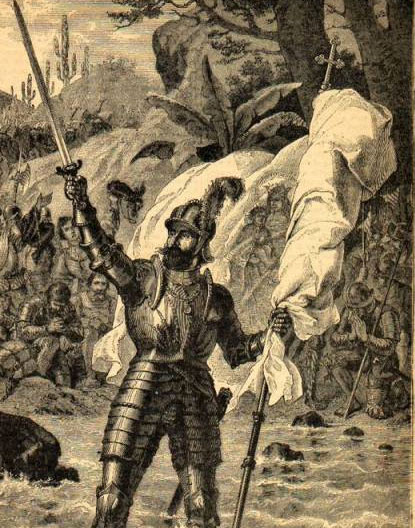
Vasco Núñez de Balboa |
Early Life and BackgroundVasco Núñez de Balboa was a Spanish explorer (or conquistador) who saw and claimed the Pacific Ocean for Spain. He was born in 1475 in a poor region of Spain known as Extremadura, which was also the home of conquistadors Hernán Cortés, Francisco Pizarro, Hernando de Soto, and Francisco de Orellana. Balboa’s family was poor, and he left Spain to seek his fortune in the New World. Balboa's Journey to the New WorldSometime around the year 1500, Balboa joined a Spanish expedition to what is now Colombia. After returning to the island of Hispaniola (which is now Haiti and the Dominican Republic), he attempted to raise pigs but was unsuccessful and accrued significant debt. In 1510, he, along with his dog, Leóncico, stowed away on a supply boat headed for the San Sebastián colony, on the coast of Colombia, in an attempt to escape his creditors. Balboa arrived and found the colony almost abandoned because most of the colonists had been killed by natives. Balboa suggested they move to the western side of the isthmus of Panama, where the natives were more peaceful, and the soil was more fertile. Founding of Santa Maria la Antigua del DarienUpon their arrival on the isthmus, however, 500 native warriors engaged them in battle. The Spanish prevailed, and Balboa founded the first permanent European settlement in the Western Hemisphere, naming it Santa María la Antigua del Darién. The Search for the Pacific OceanIn 1513, Balboa led an expedition to search for gold across the isthmus of Panama, based on information obtained from local natives. His expedition included 190 Spaniards, several native guides, and a pack of dogs. After three grueling weeks through the dense jungle and several deadly battles with natives along the way, Balboa sighted the Pacific Ocean, then known as the South Sea, on September 25, 1513. He claimed the ocean and all adjoining land for Spain. He became the first Spanish explorer to sight the Pacific Ocean from the New World. His discovery paved the way for additional Spanish exploration of the west coast of South America. Balboa's Relationship with Governor DavilaIn 1514, King Ferdinand II appointed Pedro Arias Dávila as the new governor of Darién. Balboa himself was named the governor of Panama and Coiba but would be subordinate to Dávila. In 1517, Dávila, who was threatened by and jealous of Balboa, reluctantly gave him permission to begin a second expedition to conquer the Pacific Ocean and surrounding lands. To stage the expedition, Balboa’s ship would be carried in pieces across the isthmus of Panama, through the jungle, and over the mountains, to be reassembled on the Pacific coast. Balboa's Downfall and ExecutionDuring Balboa’s expedition, however, Dávila began scheming against him and had him arrested for treason in 1519. In the unjust trial that ensued, tried by a close ally of Dávila, Balboa was convicted and beheaded, along with four of his fellow explorers. Discussion QuestionsEarly LifeVasco Núñez de Balboa was a Spanish explorer born in 1475 in a poor part of Spain. He wanted a better life, so he left Spain to explore the New World. Journey to the New WorldAround the year 1500, Balboa went to South America with other explorers. He later moved to the island of Hispaniola but had money troubles. To escape his debt, he hid on a ship going to Colombia. He helped move a struggling colony to a better place in Panama. First SettlementBalboa and his men fought off a native attack and started a new town called Santa María la Antigua del Darién. It became the first permanent European settlement in the Americas. Finding the Pacific OceanIn 1513, Balboa led an expedition across the jungle in Panama. After a hard trip, he saw the Pacific Ocean for the first time and claimed it for Spain. This discovery helped other explorers later on. Trouble with the GovernorA new governor, Pedro Arias Dávila, didn’t trust Balboa. He let Balboa plan another trip, but then had him arrested and accused of treason. In 1519, Balboa was put on trial and executed. |
| Balboa Activities |
|